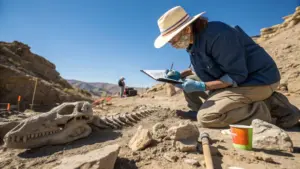
Our team recently concluded an exciting paleontological dig in Rompon, revealing significant insights into the region’s prehistoric past. The dig site, carefully selected based on geological surveys and historical data, proved to be a treasure trove of fossilized remains. We unearthed a variety of specimens, including plant fossils, invertebrate imprints, and even fragments of larger vertebrate skeletons. These findings contribute significantly to our understanding of the ancient ecosystems that once thrived in this area.
The meticulous process of excavation involved careful layering techniques and precise documentation of each find. We employed advanced tools and technologies, such as ground-penetrating radar and 3D scanning, to ensure the preservation and accurate recording of the unearthed artifacts. Our team of experts, including paleontologists, geologists, and volunteers, worked tirelessly to extract, clean, and catalog each specimen. The collaborative effort was crucial in maximizing the scientific value of the dig.
These discoveries will be instrumental in furthering our research on the region’s paleontological history. We plan to conduct further analysis on the fossils, including carbon dating and comparative studies, to determine their age and evolutionary relationships. The findings will be published in scientific journals and presented at conferences, contributing to the broader scientific community’s knowledge of prehistoric life. We are also developing educational programs and exhibits to share these discoveries with the public, fostering a greater appreciation for our natural heritage.